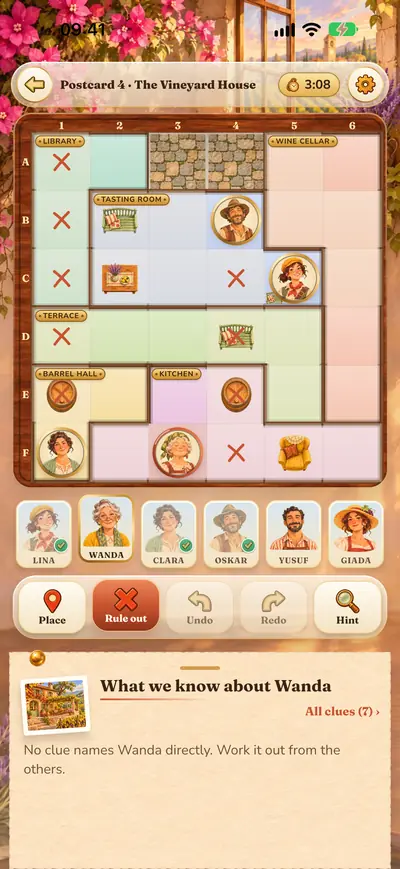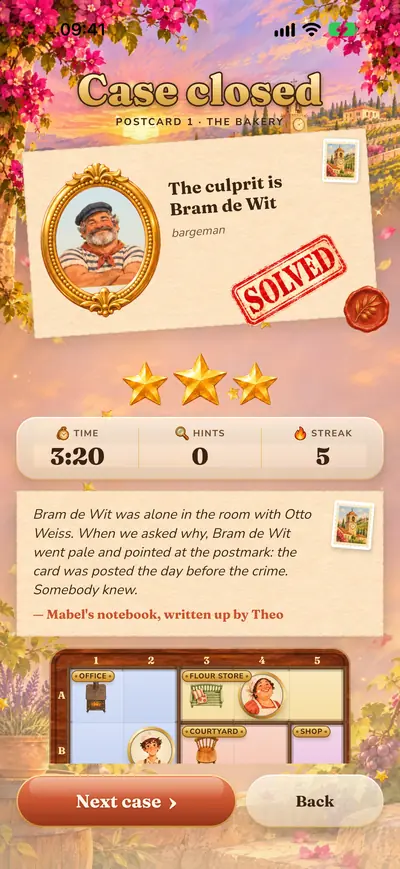

Under the story, each Mystery Games case is a logic grid: an n×n plan, n suspects, one per row and one per column, like the digits of a sudoku. The clues narrow down each person's cells until only one arrangement fits. Here is how to read them well.
Five levels
The daily case gets harder through the week. The app adds a 4×4 practice level and the 8×8 Extreme level.
 Easy · 5×55 suspects. Clues point straight at the answer.
 Medium · 6×66 suspects. Clues about pairs, rooms and furniture.
 Hard · 7×77 suspects. A careful "what if" is needed.
 Extreme · 8×88 suspects. Almost no direct clues: pure deduction.
Deductions that come up all the time
The last free cell in a line
When five of six rows are taken, the sixth suspect must use the last row. Shaded rows and columns on the plan show this at a glance.
Furniture narrows fast
“Sat on a chair” allows only the cells with a chair. “Next to a bench” allows the eight cells around each bench, minus walls of the street and blocked cells. “Not next to any barrel” removes those same rings.
Corners and the outer wall
A corner of a room is a cell with that room's walls on two touching sides; a long room has more corners than you think, and an L-shaped one has an inner corner too. The outer wall is every cell that touches the edge of the plan or the street.
Pairs of people
“Same room” and “side by side” clues only bite when one of the two has few options. Come back to them after the single-person clues.
The victim's room
Exactly one suspect is in it. If two suspects can only be in that room, the case breaks, so one of them must be elsewhere. That is often the key on hard days.
Examples from past days


 BedroomTasting RoomKitchenLibraryTerracePress House


 BallroomCloakroomMayor's OfficeRecords RoomBalconyGrand StaircaseCouncil Chamber